The Saturn Rally: Why a Failed Console's Sealed Library Is Outpricing Its Contemporaries
Sega Lost the 32-Bit War by Ten to One. Three Decades Later, That Defeat Is the Asset.
Nostalgix Research, Monthly Research Brief | October 2026 | Confidential, Client Use Only
In August 1997, two years into the 32-bit generation, the United States console market had resolved itself into a verdict. Sony held 47 percent. Nintendo held 40 percent. Sega held 12 percent, and the Saturn, the machine Sega had rushed to market four months ahead of schedule in a surprise May 1995 launch, was already being written off inside the company that made it. The PlayStation had undercut it by $100 at retail. The Nintendo 64 had taken the remaining oxygen. By late 1998 Sega had discontinued the Saturn in North America entirely, redirecting retail attention to the Dreamcast.
The Saturn finished its life at roughly 9.26 million units sold worldwide, against a PlayStation install base that would eventually approach 100 million. Sega sold roughly nine consoles for every hundred Sony sold. Measured by the standard the industry uses, the Saturn is the clearest commercial failure of its generation outside of the 3DO and the Jaguar.
That failure is now the mechanism producing the price behaviour in this brief. The Saturn library is being repriced not because the console won anything, but because every structural consequence of losing (small North American print runs, late-cycle titles manufactured in batches of a few thousand, a retail channel that cleared inventory rather than warehoused it, and a Japanese catalogue that never crossed the Pacific at all) now reads as supply constraint.
Saturn worldwide hardware sales
9.26M
Sega US console share, August 1997
12%
Panzer Dragoon Saga, sealed (PriceCharting)
$2,177
Mega Man 8 (Saturn), pristine complete
$1,100+
What the Record Books Actually Say: $1.56M, $480,000, and Nothing for Sega's 32-Bit Machine
Before anything else, a correction to a claim that circulates freely in retro-gaming coverage and that we are not going to make.
The Saturn does not hold a headline auction record. It does not hold one for its generation, for Sega, or for any sub-category we can identify in the public record. The trophy results in sealed video games belong overwhelmingly to Nintendo, with one Sega outlier that has nothing to do with the Saturn:
| Lot | Platform | Result | Date / Venue |
|---|---|---|---|
| Super Mario 64, sealed, WATA A++ | Nintendo 64 | $1,560,000 | July 2021, Heritage |
| The Legend of Zelda, sealed | NES | $870,000 | July 2021, Heritage |
| John Madden Football, WATA 9.2 | Sega Genesis | $480,000 | January 2022, Heritage |
| The Legend of Zelda, first production, CGC 9.2A | NES | $375,000 | Heritage Signature Auction |
| Final Fantasy VII, sealed, WATA 9.8 A+ | PlayStation | $144,000 | Heritage |
| NES Deluxe Set, factory sealed (1986) | NES hardware | $120,000 | November, Heritage |
| Mega Man, first production run, sealed | NES | $75,000 | Heritage |
| Doom, Ridged Longbox, WATA 9.6 A+ | PlayStation | $66,000 | Heritage |
The Madden result, $480,000 for a 1990 Genesis copy pulled from John Madden's own office and graded WATA 9.2, remains the record for a sports video game. It is a Sega result, and it tells us almost nothing about the Saturn. Provenance carried that lot; the console it ran on was incidental.
So the claim this brief makes is narrower than "Saturn sets records." The Saturn premium is library-wide rather than trophy-driven. It shows up in the middle of the catalogue, on titles that shipped in the tens of thousands rather than the hundreds, and it shows up as a multiple against the same game on a competing platform. A category whose appreciation lives in its mid-tier behaves very differently from one whose appreciation lives in a handful of six- and seven-figure slabs, and the Saturn illustrates the former without a trophy tier to muddy the comparison.
Continue reading — full analysis available to Nostalgix members
Access full market analysis, deal flow, and grail-level inventory not listed publicly. Membership begins with a brief inquiry — no charge, no obligation.
Create your free accountAlready a member? Sign in
More from Nostalgix
After the Merger: What PSA's Absorption of WATA Means for Sealed Video Game Valuations
WATA's grading label disappeared in October 2025, absorbed into PSA. Ten months and one $3 million auction record later, the question of what changed, and what it means for holders of the old plastic, remains only partly answered.
The Dubai Collection: Pokémon Red, Blue & Yellow PSA Lot Sells for $2 million
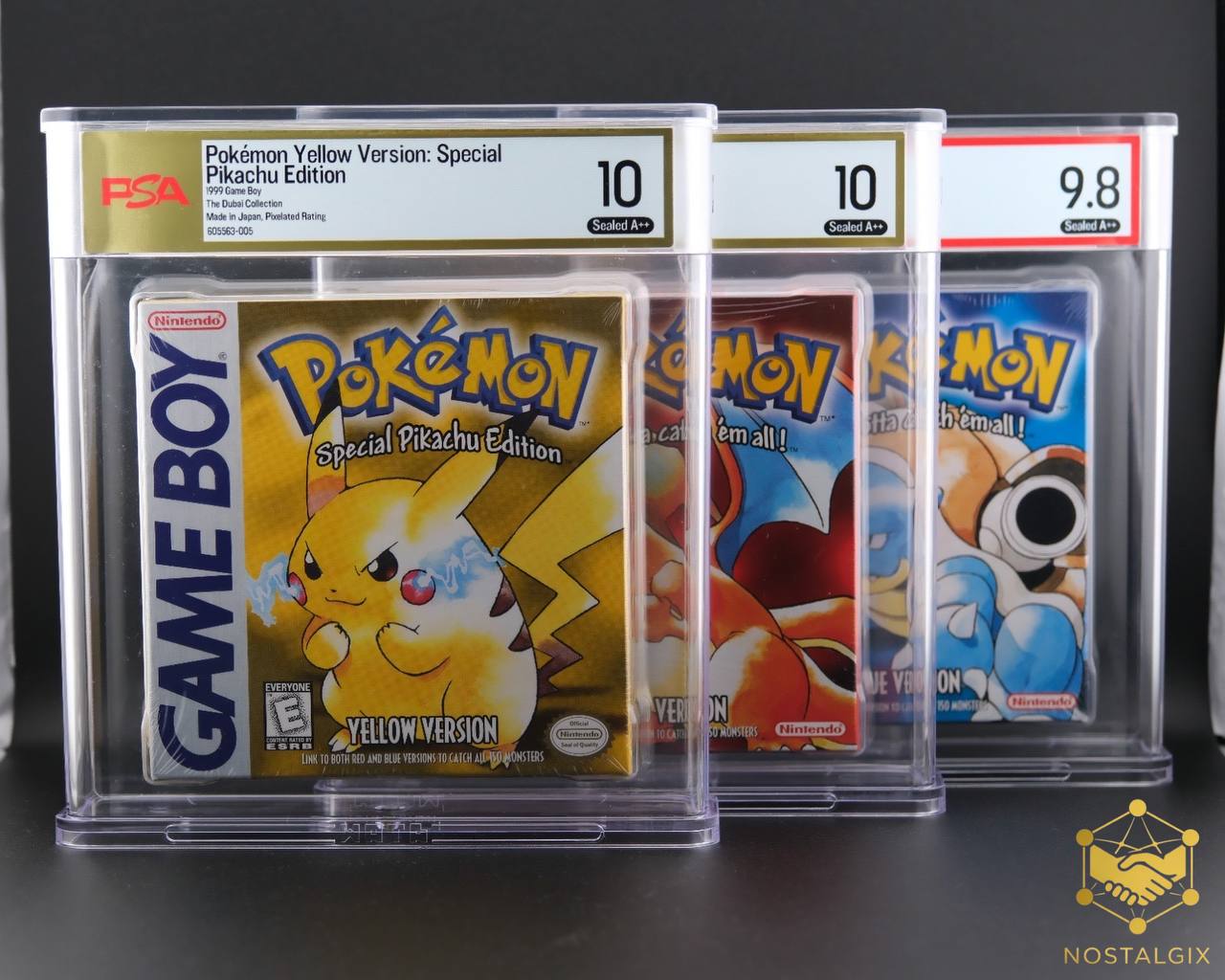
Nostalgix has brokered the sale of three sealed PSA-graded first-print Generation 1 Pokémon titles from The Dubai Collection, for $2 million. The lot marks the highest recorded sale of Pokémon video games in history.
The $3 Million Mario and the Re-Anchoring of the Trophy Tier
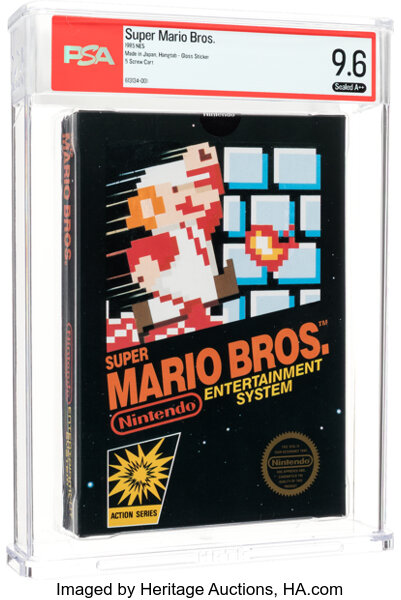
A sealed Super Mario Bros. cartridge sold for $3 million in June 2026, setting a new public record for video game collectibles. This transaction clarifies a sharp division between the repriced trophy tier and the segment still navigating market corrections.