The $3 Million Mario and the Re-Anchoring of the Trophy Tier
What a Forty-Year-Old Cartridge Says About Where Real Value Now Lives in the Sealed Video Game Market
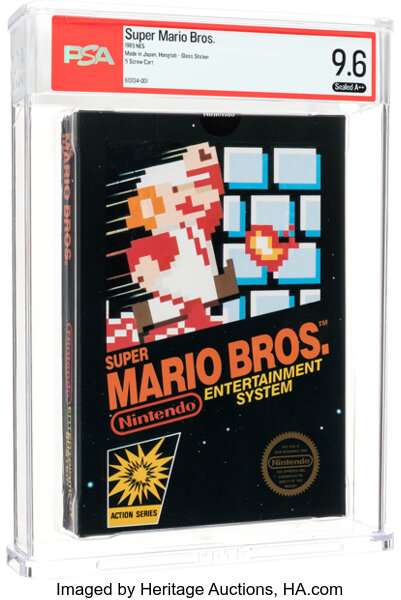
On June 12, 2026, a sealed copy of Super Mario Bros. produced in early 1986 sold at Heritage Auctions for $3,000,000. The cartridge, graded PSA 9.6 A++, had been discovered months earlier inside an unopened, launch-edition NES Control Deck console bundle. It had sat untouched for nearly forty years. The buyer receives the console as well, should they elect to break the seal.
The headline number is the easy part of this story. The interesting part is what produced it, and what it tells us about the rest of the sealed video game market.
We believe this sale, properly framed, is the most consequential single transaction in retro gaming since the 2021 peak. Not because it reflates the category. It does not. But because it draws a sharp line between the slice of the market that has structurally repriced upward over the last five years and the much larger slice that is still living with the consequences of the 2022 correction. Our clients increasingly ask whether sealed games belong in a serious collectibles allocation alongside trophy comics, vintage trading cards, and high-grade sports memorabilia. The answer, after this sale, is more decisive than it was six months ago. But it applies to a smaller portion of the category than most market commentary suggests.
Heritage Sale Price (June 12, 2026)
$3,000,000
Auction #7453 Total (116 lots)
$4.91M
Known Copies of Gloss-Sticker Variant
3
Mario 64 Peak-to-Trough (2021–2023)
-85%
The Sale Itself: What Actually Traded
Heritage Video Games Signature Auction #7453, held June 12 and 13, 2026, generated $4,908,574 in total across 116 lots. The catalog included another sealed Super Mario Bros. copy that cleared $575,000, a result that would have been the headline at any auction held before 2020. In June 2026, it was a footnote.
The lead lot, catalog number 7453-28025, was a second-production-run sealed Super Mario Bros. cartridge from early 1986. Heritage identified it via the gloss sticker Nintendo used to seal that specific variant. The grade, PSA 9.6 A++, is, per Heritage, the strongest score this particular variant has received. Only three sealed copies of the gloss-sticker variant are known to exist. This was the first time any of them appeared at public auction.
Povenance is what separates this lot from every prior video game record. The cartridge was discovered "a few months ago" still sealed inside an unopened, launch-edition NES Control Deck bundle. The seller had owned the console bundle, unaware of its contents, for roughly four decades. The cartridge inside had never been removed, never been examined, and never been graded until shortly before the auction. The original consignor's ask was $3.75 million, non-negotiable. The lot cleared at $3 million.
Evan Masingill, Heritage's Consignment Director for Video Games, characterized the result this way: "It is only appropriate that the most significant video game in the world should bring the most impressive result in the history of the hobby. The remarkable backstory, that it was just discovered a few months ago inside a brand-new Control Deck NES console bundle, meaning it has not been touched for nearly 40 years, makes the result even more impressive."
Auction History: A Five-Year Repricing of the Category Ceiling
The data below tracks the public-auction record for a single sealed video game from the pre-grading era through this month's sale. The compression of the timeline is the point. What took the comic and sports-card markets four decades to accomplish, the sealed video game market accomplished in less than seven years.
| Date | Title | Price | Notes |
|---|---|---|---|
| Jul 2017 | Pre-record era ceiling | ~$30,000 | Pre-WATA market |
| Jul 2019 | Super Mario Bros. (NES) | $100,000 | First six-figure NES sale |
| Jun 2020 | Super Mario Bros. (sealed hangtab) | $114,000 | Early WATA-era result |
| Dec 2020 | Super Mario Bros. 3 | $156,000 | Sequel benchmark |
| Apr 2021 | Super Mario Bros. (NES) | $660,000 | WATA 9.6 A |
| Jul 2021 | The Legend of Zelda (NES) | $870,000 | Heritage |
| Jul 2021 | Super Mario 64 | $1,560,000 | WATA 9.8 A++, prior public record |
| Aug 2021 | Super Mario Bros. (NES) | $2,000,000 | Private sale, WATA 9.8 A++ |
| Jun 2026 | Super Mario Bros. (gloss-sticker variant) | $3,000,000 | PSA 9.6 A++, current public record |
Public-Auction Record for a Single Sealed Video Game (USD, Year-End High)
Two observations from the data. The first is that the record-setting concentration is almost entirely Nintendo first-party from 1985 to 1996. Mario, Zelda, and Mario 64 together account for every public-auction record above $500,000. This is the same concentration pattern that defined the early comic-collecting market, where Action Comics #1, Detective Comics #27, and a small number of other Golden Age keys absorbed nearly all of the trophy-tier capital. The second is that the gap between the 2021 peak and the June 2026 result is roughly five years. That interval matters, because it is exactly long enough for the 2022 correction to have fully played out and for new buyers to have entered the market under different assumptions than the 2021 cohort.
The 2022 Correction: The Story Behind the Story
Any analysis of the June 2026 sale that does not begin with what happened between August 2021 and the end of 2023 is misleading. The market that produced the $3 million Mario is the same market that produced an 85% peak-to-trough drawdown in the most prominent comparable lot of the prior cycle.
In July 2021, a sealed Super Mario 64 graded WATA 9.8 A++ sold for $1,560,000. It held the public-auction record for a single video game for nearly five years. By 2023, comparable sealed copies of Super Mario 64 were trading at approximately $240,000. That is roughly an 85% decline. Other titles followed similar paths at lower absolute prices. A sealed Super Mario World on Super Nintendo, WATA 9.4 A, sold for $144,000 in October 2021 and traded at $125,000 by May 2024, a far gentler correction but a correction nonetheless. A sealed Game Boy console graded 85 NM+ sold for $21,000 in April 2022 and $16,200 by January 2023.
The proximate cause of the correction was a confluence of three events. In August 2021, investigator Karl Jobst published a video alleging coordinated price manipulation between WATA Games, the dominant video-game grader at the time, and Heritage Auctions. In May 2022, a class-action lawsuit was filed in the Central District of California alleging the same conduct, with an estimated class of approximately 10,000 affected purchasers. The complaint alleged shill bidding, conflicts of interest involving WATA employees consigning their own graded material, and misrepresentation of grading turnaround times. Confidence in the sealed-game market, which had been built almost entirely on grading certification, collapsed.
The lawsuit remains unresolved as of June 2026. No settlement, dismissal, or trial date has been publicly reported. This is a material fact that any allocator considering sealed video games as a portfolio category should hold in front of mind, not behind it. An adverse ruling, or a settlement involving disclosure, would re-price the entire category. The risk is concentrated in WATA-graded material from the 2019 to 2022 vintage, and is meaningfully lower for PSA-graded material, but no segment of the category is fully insulated.
The WATA Overhang Is Still Live
Continue reading — full analysis available to Nostalgix members
Access full market analysis, deal flow, and grail-level inventory not listed publicly. Membership begins with a brief inquiry — no charge, no obligation.
Create your free accountAlready a member? Sign in
More from Nostalgix
After the Merger: What PSA's Absorption of WATA Means for Sealed Video Game Valuations
WATA's grading label disappeared in October 2025, absorbed into PSA. Ten months and one $3 million auction record later, the question of what changed, and what it means for holders of the old plastic, remains only partly answered.
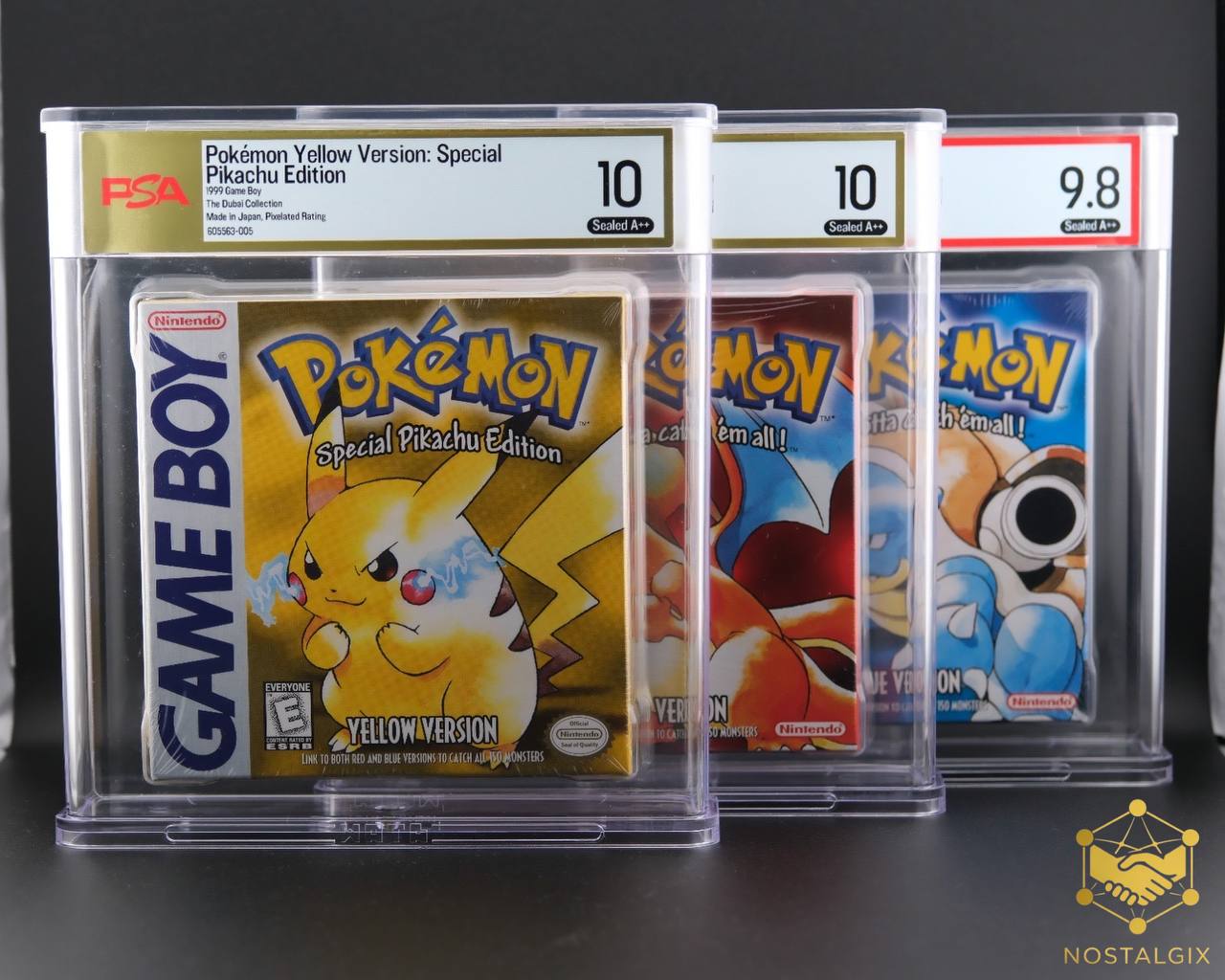
The Dubai Collection: Pokémon Red, Blue & Yellow PSA Lot Sells for $2 million
Nostalgix has brokered the sale of three sealed PSA-graded first-print Generation 1 Pokémon titles from The Dubai Collection, for $2 million. The lot marks the highest recorded sale of Pokémon video games in history.
Serial Numbers as Scarcity: The Pricing Logic of the 1997 Precious Metal Gems Emerald
Ten copies, printed once in 1997, never repeated. A PSA 5 Kobe Bryant Emerald just sold for $3.15M, and the reason a mid-grade card set the record says more about scarcity than about condition.