The $1.9 Million Sketch: What Thomas Taylor's Sotheby's Result Establishes for Franchise Illustration Art
A Graduate's Modest Fee and the Largest Repricing Any Illustration Sub-Category Has Recorded
Nostalgix Research, Monthly Research Brief | September 2026 | Confidential, Client Use Only
A flat fee is a transfer of optionality. The illustrator takes cash today; the publisher takes whatever the image becomes. In 1996 a 23-year-old named Thomas Taylor, one year out of Anglia Ruskin University, took the cash. Reports of the amount differ (Galerie Magazine puts it at roughly $650, Taylor's own account cited on his Wikipedia entry says "two or three hundred pounds"), but every source agrees on the structure: a modest one-time payment to an unknown illustrator for a cover job at a children's publisher, on a first novel by an unproven author.
On June 27, 2024, that pencil-and-watercolour cover illustration for Harry Potter and the Philosopher's Stone sold at Sotheby's New York for $1.9 million. Four bidders, phone and online, contested it for nearly ten minutes. The hammer landed at roughly 3.2 times the high estimate, against a pre-sale range Sotheby's had already described as the most aggressive ever placed on a Harry Potter item of any kind.
The interesting number here is not $1.9 million. It is the ratio between that figure and what the category had previously been willing to pay for the exact same kind of object. The record Taylor's sheet broke, $471,000 for a signed first edition at Heritage in 2021, was a printed book. The record it broke within illustration art, E.H. Shepard's Hundred Acre Wood map at roughly $569,000, was held by an artist with a century of art-historical standing. Taylor had neither. He had the franchise.
Taylor cover illustration, Sotheby's New York, June 27 2024
$1.9M
Same artwork, Sotheby's London, 2001
£85,750
Previous illustration-art record (E.H. Shepard, 2018)
$568,761
Previous Harry Potter auction record (any item, 2021)
$471,000
The Sale Itself: What Actually Traded
The lot was a single sheet: Taylor's original pencil-and-watercolour artwork for the 1997 Bloomsbury first edition, the image that introduced the scarred boy on Platform Nine and Three-Quarters to the world. It came to market from the Library of Dr. Rodney P. Swantko, a collection built around 19th and 20th century English and American literature. That provenance matters more than it appears to. The work was catalogued and sold within a fine books and manuscripts context rather than as pop-culture memorabilia, and the buyer pool it reached reflected that framing.
Sotheby's estimated $400,000 to $600,000. The house was not being timid. That band already sat above anything a Harry Potter item had ever been formally asked to justify, and it implied roughly a 5x uplift on the artwork's own prior trade. The result cleared it by more than three times.
Four bidders is the detail worth underlining. A record set by two determined parties is a record about two people. A record contested by four across two channels for ten minutes is a record about a price level, because it shows the second, third, and fourth-deepest pockets in the room were all still live well into seven figures. The underbid is where the durable comp lives, and in this case the underbid was itself a category record by a wide margin.
Buyer identity was not disclosed, which is standard for the house and for sales of this size. No credible attribution has surfaced in any coverage we've reviewed, and any circulating claim of identity should be treated as unsourced.
The Underbid Is the Comp
A single-buyer record can be an outlier. A record where four participants competed for ten minutes establishes that the price band, not just the peak, has been repriced. The relevant question after June 2024 is not what one collector paid for the Taylor sheet, but what the three who lost it went looking for next.
Continue reading — full analysis available to Nostalgix members
Access full market analysis, deal flow, and grail-level inventory not listed publicly. Membership begins with a brief inquiry — no charge, no obligation.
Create your free accountAlready a member? Sign in
More from Nostalgix

Does Animation Art Need Authentication to Grow?
The animation art market is experiencing record demand and price discovery, with significant institutional interest. However, it remains one of the only major collectibles categories operating at scale without a centralized authentication standard, creating a critical structural gap.
Serial Numbers as Scarcity: The Pricing Logic of the 1997 Precious Metal Gems Emerald
Ten copies, printed once in 1997, never repeated. A PSA 5 Kobe Bryant Emerald just sold for $3.15M, and the reason a mid-grade card set the record says more about scarcity than about condition.
Nostalgix Brokers $2.5M Private Sale of PSA 10 Gold Star Torchic
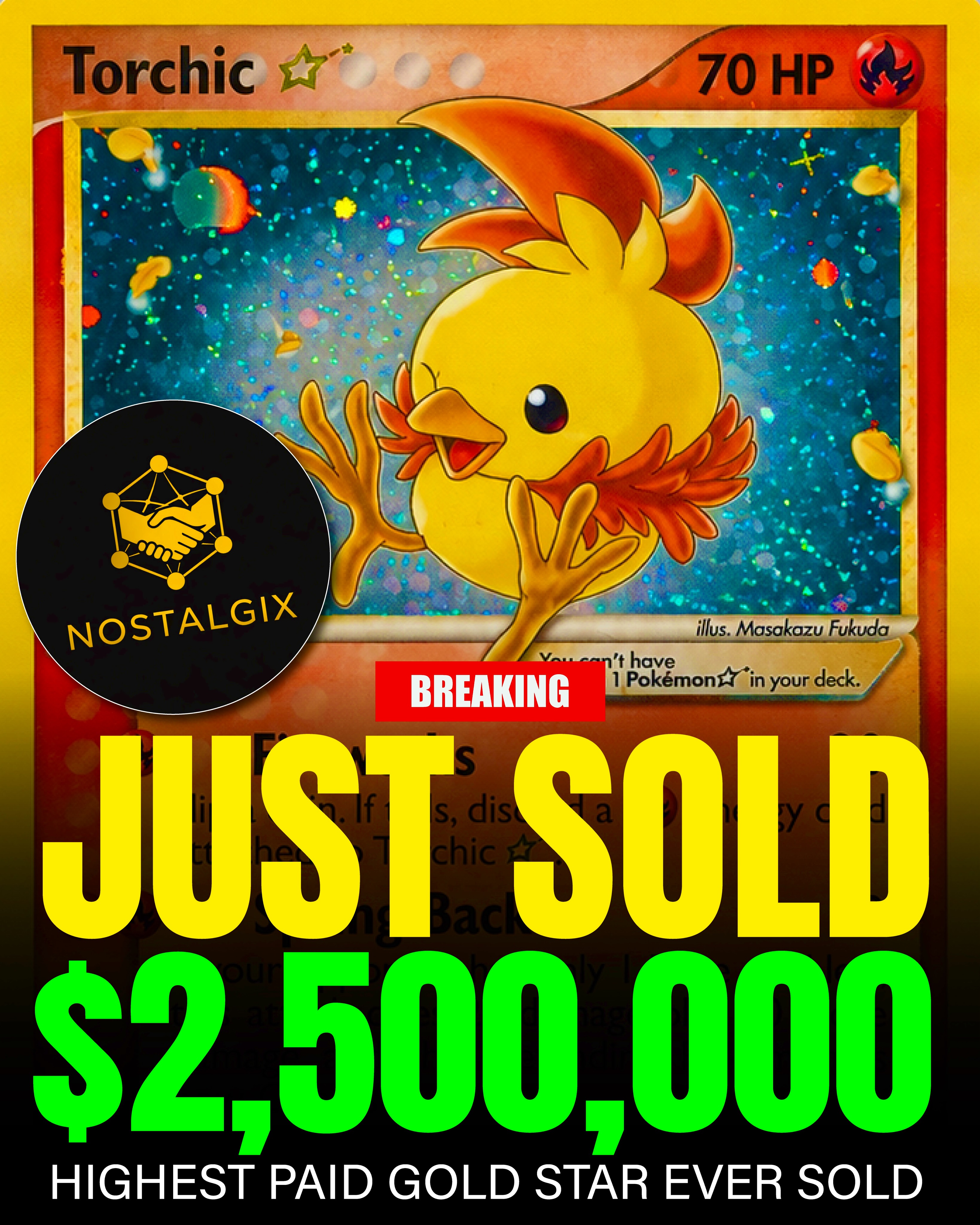
Nostalgix has brokered the private sale of a PSA 10 Gold Star Torchic for $2,500,000, one of the highest Pokemon card sales ever recorded. The deal closed with full anonymity for both buyer and seller.